The Zero-Waste Grocery Blueprint: Mastering the Cross-Utilisation Menu
A low-waste grocery week requires culinary mathematics that our brains are often too tired to perform. Here is how to use an AI assistant to build a zero-waste cross-utilisation matrix, safely meal-prep the results, and eliminate Wednesday's rotting vegetables.
The Anatomy of the Wednesday Wilting Point
The ambition of a low-waste grocery week usually perishes on a Wednesday. It happens right around the moment a dinner recipe demands a quarter of a red cabbage, three sprigs of coriander, and half a lemon. You are forced to buy the whole cabbage, the entire bunch of herbs, and a net of citrus. By Friday, the unused portions have formed a depressing, quietly decaying ecosystem in the bottom drawer of your fridge.
Achieving a genuinely low-waste grocery week is not about willpower; it is a complex puzzle of ingredient cross-utilisation. You need the half-cabbage from Tuesday’s tacos to seamlessly integrate into Thursday’s noodle salad. In 2026, using a generative AI assistant to perform this culinary mathematics is the smartest shortcut a capable adult can take—provided you understand exactly where the digital chef's authority ends and your safety responsibilities begin.
The 2026 Shift: Separation of Powers in the Kitchen
A few years ago, the trend was to ask a chatbot to manage our entire kitchen ecosystem, from writing the menu to telling us how long our meal prep could sit on the benchtop. That approach has proven fundamentally flawed. As the New Zealand Office of the Privacy Commissioner explicitly warns, generative AI tools frequently produce "very confident errors of fact or logic." They strongly advise that you must "ensure human review prior to acting" to mitigate the risk of acting on inaccurate information.
In a kitchen setting, a confident error of fact is a biological hazard. If you ask an AI how long your freshly roasted vegetables can sit on the kitchen bench to cool, it might cheerfully hallucinate a four-hour window that leaves you dangerously unwell. AI optimises for a polite, plausible-sounding response, not food safety.
The practical relevance for household meal prep is a strict separation of powers. We now use the AI purely as a creative puzzle-solver to map our grocery list, but we apply official, scientifically grounded guidelines to handle the food. Specifically, we rely on the Food Standards 2-hour/4-hour rule. This rule is scientifically verified, taking into account how rapidly bacteria multiply when meals sit at temperatures between 5°C and 60°C.
The rule is beautifully simple, provided you remember that the time is cumulative. Once your food drops below 60°C (the temperature of a hot meal) or rises above 5°C (the temperature of your fridge):
- Less than 2 hours: The food can be used immediately or returned to the fridge for later.
- Between 2 and 4 hours: The food can be eaten right away, but you cannot put it back into the fridge.
- More than 4 hours: The food must be thrown in the bin.
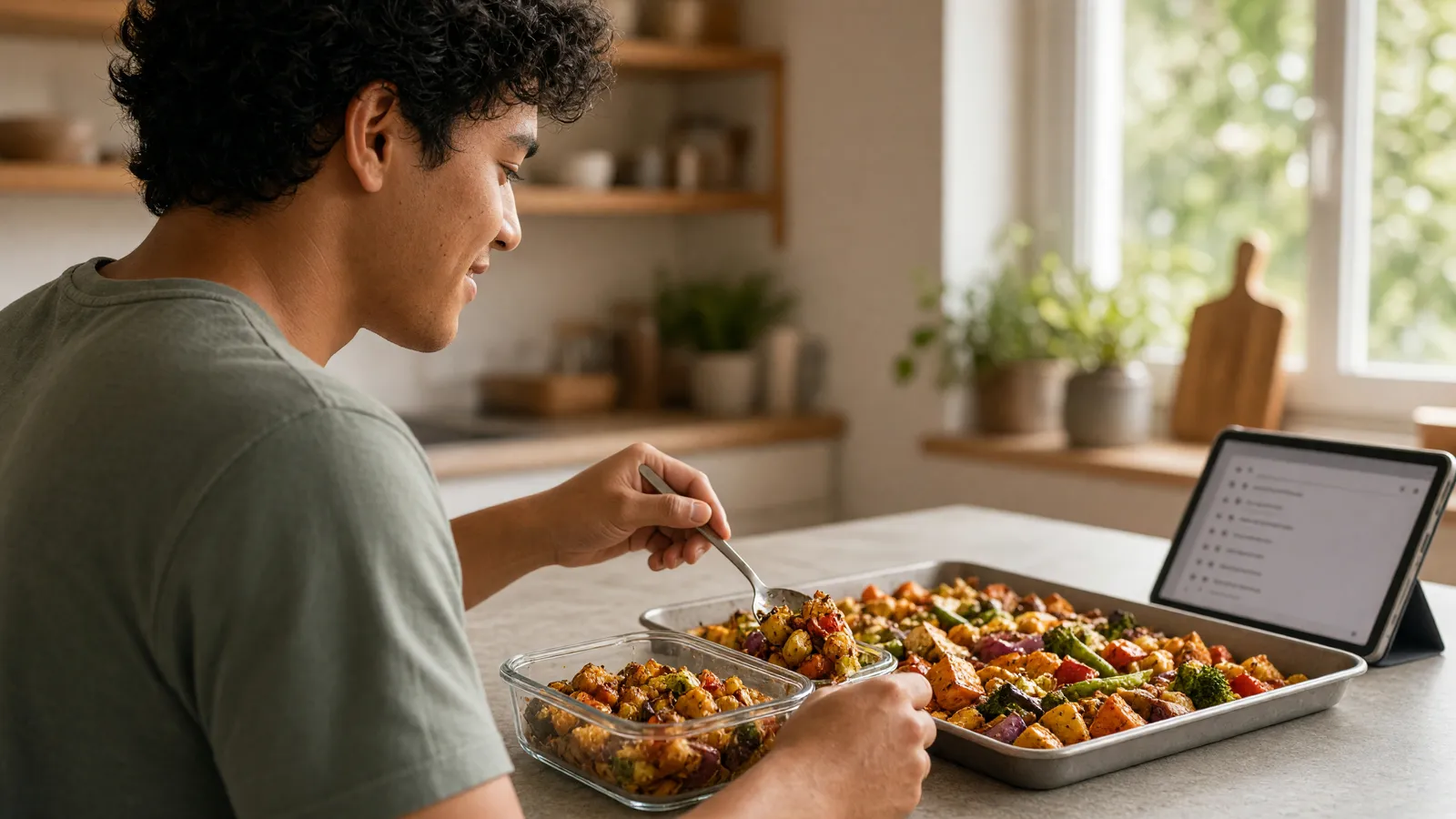
Today, we are going to use an AI to architect a zero-waste cross-utilisation menu, and then we are going to head into the kitchen to safely bulk-cook the "Master Root & Pulse Foundation Tray"—the linchpin of your low-waste week, cooled and stored perfectly within the two-hour window.
The Finish Line
A completed zero-waste grocery matrix, a copyable AI planning prompt, and a hot, safely portioned Master Foundation Tray ready to anchor three different lunches throughout your week.
- Time Estimate: 10 minutes to prompt and plan, 10 minutes active prep, 30 minutes roasting. Total: 50 minutes.
- Cost Estimate: Free to plan. Grocery costs will vary, but roughly $15–$20 for the master tray ingredients.
- Prerequisites: A standard web-based AI chat tool (such as ChatGPT, Claude, or Microsoft Copilot), a large roasting tray, airtight glass or plastic storage containers, and basic kitchen equipment.
Step 1: The Cross-Utilisation Prompt
We are going to force the AI to build a menu where every purchased ingredient is consumed across three distinct meals. By severely constraining the AI's ability to add random ingredients, we eliminate the Wednesday wilting point.
Open your AI assistant and copy and paste the following prompt. Do not include any personal or confidential household information.
Copyable Prompt:
"Act as a strict, zero-waste meal planner. I want to plan three distinct dinners for two adults. Provide a tightly constrained grocery list that relies heavily on ingredient cross-utilisation so that absolutely zero fresh produce is left over at the end of the three meals. Include a 'Master Foundation Tray' of roasted vegetables and pulses that will be bulk-cooked on Sunday and used in different ways across the three meals. I already possess standard pantry staples (olive oil, salt, pepper, cumin, smoked paprika). Format the output as: 1. The exact shopping list. 2. The cross-utilisation matrix (showing how each ingredient is split). 3. The three dinner concepts."
Illustrative AI Output
(Note: This is a representative example of what a constrained AI will produce. Your actual results will vary based on the AI model.)
1. Shopping List:
1 large head of broccoli (florets and stems), 800g kumara, 2 large red onions, 1 bag of baby spinach (150g), 1 block of feta cheese (200g), 1 tin of chickpeas (400g), 1 packet of wholemeal wraps (6 pack), 6 free-range eggs.
2. Cross-Utilisation Matrix:
- Kumara: Roasted whole batch on Sunday. Used in Meals 1, 2, and 3.
- Broccoli: Florets and peeled stems roasted on Sunday. Used in Meals 1 and 2.
- Red Onion: 1.5 onions roasted on Sunday. 0.5 onion pickled quickly for Meal 3.
- Feta Cheese: Crumbled across Meals 1 and 2.
- Spinach: Split evenly as a fresh base for Meals 1, 2, and 3.
3. The Meals:
- Meal 1: Warm Foundation Tray Salad with Feta and Lemon.
- Meal 2: Foundation Tray Vegetable Wraps with Hummus.
- Meal 3: Foundation Tray Frittata (using the last of the roasted veg and eggs).
Step 2: The Master Root & Pulse Foundation Tray
Now that the AI has solved the culinary mathematics, we step into the real world to execute the cook. This foundation tray is designed to use every edible part of the vegetables, minimising trimmings and providing a robust, flavourful base for the week.
Ingredients
- 800g kumara, scrubbed and diced into 2cm cubes (leave the skin on for zero waste)
- 1 large head of broccoli (cut the florets; peel the tough outer skin off the main stem, then dice the inner stem to match the kumara size)
- 2 large red onions, peeled and cut into thick wedges
- 1 400g tin of chickpeas, drained and rinsed
- 3 tablespoons olive oil
- 1.5 teaspoons smoked paprika
- 1 teaspoon ground cumin
- 1 teaspoon sea salt
- A generous grind of black pepper
The Kitchen Execution
- Preheat the Oven: Preheat your oven to 200°C (180°C fan-bake).
- The Mix: Place the diced kumara, broccoli florets, diced broccoli stems, red onion wedges, and drained chickpeas onto your largest roasting tray. If they are crowded, split them across two trays; crowding causes vegetables to steam rather than roast.
- The Seasoning: Drizzle the olive oil over the vegetables. Sprinkle the smoked paprika, cumin, salt, and pepper evenly across the tray. Use your hands to toss everything thoroughly until every piece is glossy and coated.
- The Roast: Place the tray in the oven for 25 to 30 minutes. Toss halfway through. You are looking for tender kumara, slightly charred broccoli edges, and chickpeas that have crisped up.
- The Safety Clock: Remove the tray from the oven. This is where your human oversight begins. As the tray cools down below 60°C, the cumulative food safety clock starts ticking.
Step 3: Managing the 2-Hour/4-Hour Rule
The greatest threat to a low-waste week is ruining your bulk prep through improper cooling. Leaving your roasted tray on the benchtop for the entire afternoon while you run errands is a recipe for disaster.
According to the Food Standards guidelines, because you intend to put this food back in the fridge to use later in the week, the total cumulative time it spends between 5°C and 60°C must be less than two hours. Start timing as soon as the tray comes out of the hot oven.
To cool the food rapidly and safely:
- Do not leave the vegetables in a massive, dense pile on the hot roasting tray.
- Immediately transfer the roasted vegetables into your shallow, airtight glass or plastic storage containers, but leave the lids off. Spreading the food out increases the surface area and drops the temperature faster.
- Once the steam has stopped rising and the food is roughly room temperature (this should take about 30 to 45 minutes), seal the containers tightly.
- Place the containers directly into the fridge (which should be running at 5°C or below).
Because you have secured the food in the fridge well before the two-hour limit, you can confidently use these ingredients over the next three to four days without playing food poisoning roulette.
Checks, Failures, and Maintenance
How to Check It Worked
A successful foundation tray will have distinct, unbroken pieces of vegetable that hold their shape when tossed into a salad or folded into a wrap. By Thursday evening, your fridge vegetable drawer should be completely empty, fulfilling the promise of a low-waste week.
Common Failures and Recovery
- The Soggy Tray: If your vegetables steamed instead of roasting, you likely crowded the pan or didn't use a hot enough oven. Next time, use two trays. You can recover soggy roasted vegetables by repurposing them into a blended soup or folding them tightly into a frittata where texture matters less.
- The Forgotten Cooling Clock: If you get distracted and leave the roasted vegetables on the benchtop for three hours, you have crossed a strict safety threshold. According to the 2-hour/4-hour rule, the food is still safe to eat right now, but it cannot be put into the fridge for later. Your only recovery is to invite the neighbours over and eat the entire tray immediately. If it hits four hours, it must go in the bin.
Maintenance and Reuse
Save your successful cross-utilisation prompts in a digital note. Once you find a matrix that perfectly suits your household's tastes—perhaps swapping the kumara for pumpkin, or the chickpeas for black beans—you have a repeatable blueprint that requires zero mental energy on a Sunday morning. You just run the formula, mind the cooling clock, and enjoy a week where nothing goes to waste.
AI disclosure: AI systems assisted with research and writing. Gemini independently peer-reviewed and approved this article before publication. Images, where present, are illustrative AI-generated photographs.